
Finding Faribault Residents Through Records
Faribault does not have one official roster of everyone who lives in town. Rice County, the City of Faribault, Minnesota agencies, the courts, and local repositories each keep different records. Start with the fact already known. A present address is best anchored in a county parcel record. A document number or legal description belongs with the Recorder. A current registration question belongs with the state lookup and Rice County Elections. A past household needs a dated directory, map, newspaper, census, or archive record.
Use two independent fields before connecting names. The city name alone can mean the incorporated city, a Faribault mailing address, a Rice County township, or a county record filed in the county seat. A parcel identification number, record date, full address, volume year, case number, or birth year makes the trail more dependable. A name-only hit, a missing portal result, or an old owner field is not proof of present residence.
- Fix the geography and year first. Note whether the address is in Faribault city, a township, or simply uses a Faribault mailing address.
- Search the county parcel route for an address or PIN, then save the returned map date and parcel identifier.
- Use the Recorder route for a deed, plat, mortgage, lien, or certificate-of-title question. Record the document number and recording date.
- Use MNVotes only for an individual registration-status question, then contact Rice County Elections if the address or street format fails.
- For an earlier household, compare the nearest Polk directory years with newspapers, maps, census material, or a repository request.
Note: Keep the search date and exact spelling with every result so a later check can distinguish a changed record from an earlier search.
Faribault Residents Directory Custodians
The main Faribault resident records routes are grouped at the Rice County Government Services Building, but their duties are separate. The Recorder keeps recorded land documents, certificates of title, and local vital and marriage service. The Assessor provides valuation and property-map access. Property Tax & Elections handles local election functions. Court Administration, the city, and the historical repositories have their own files and access rules. Contact the office that created or maintains the series rather than sending one broad request.
Rice County Recorder / Registrar of Titles
320 Third St NW
Faribault, MN 55021
507-332-6114
Rice County Assessor
320 Third St NW
Faribault, MN 55021
507-332-6102
Rice County Property Tax & Elections
320 Third St NW
Faribault, MN 55021
507-332-6104
Inspection of public records is free under the Recorder's stated policy, while copies, certification, and electronic delivery can have separate charges. Rice County's fee schedule and office hours are dated information. Confirm the current posting before ordering, mailing payment, or making a trip.
Faribault Parcel Fields and Address Clues
The Rice County Beacon workflow begins with a property search, an address or parcel, a selected result, and the map tab. Its live field labels were not available during the research review, so the verified field inventory comes from the county's public ArcGIS parcel layer. That layer separates owner and tax-mailing information from the address and parcel identifiers that locate land. An owner or mailing field is a public-record lead, not a claim that someone currently occupies the location.
The Rice ArcGIS parcel layer documents the field categories below. Save the 14-character county PIN and the query date. A legal description and lot/block reference may remain more stable than a street address when a subdivision or numbering convention changes.
| Verified parcel field | Use in a Faribault search |
|---|---|
| COUNTY_PIN / STATE_PIN | Identifies the county or state parcel record. |
| OWNER_NAME and tax-name fields | Provides a recorded owner or tax contact lead to verify elsewhere. |
| Street components and ANUMBER | Connects house number, directional parts, and street spelling. |
| ZIP / ZIP4 and post community | Supports address checking, not a final postal-boundary conclusion. |
| Plat, lot, block, subdivision, recorded date | Helps connect the map result to a deed or recorded instrument. |
Note: Beacon returned an access limitation during the research review, so verify live labels and results directly in the county system.
Faribault Voter Status Search Fields
The Minnesota Secretary of State provides an individual registration-status tool, not a broad public name directory. Its route asks for first name, last name, date of birth, then either ZIP or county before city or township, house number, street, and an optional unit field. The interface is updated nightly. A new registration can take up to 14 days to appear, and an address mismatch should be routed to Rice County Elections rather than treated as a final result.
The MNVotes registration lookup screen uses a ZIP or county route before the address fields. This image records the official interface available during the research capture.
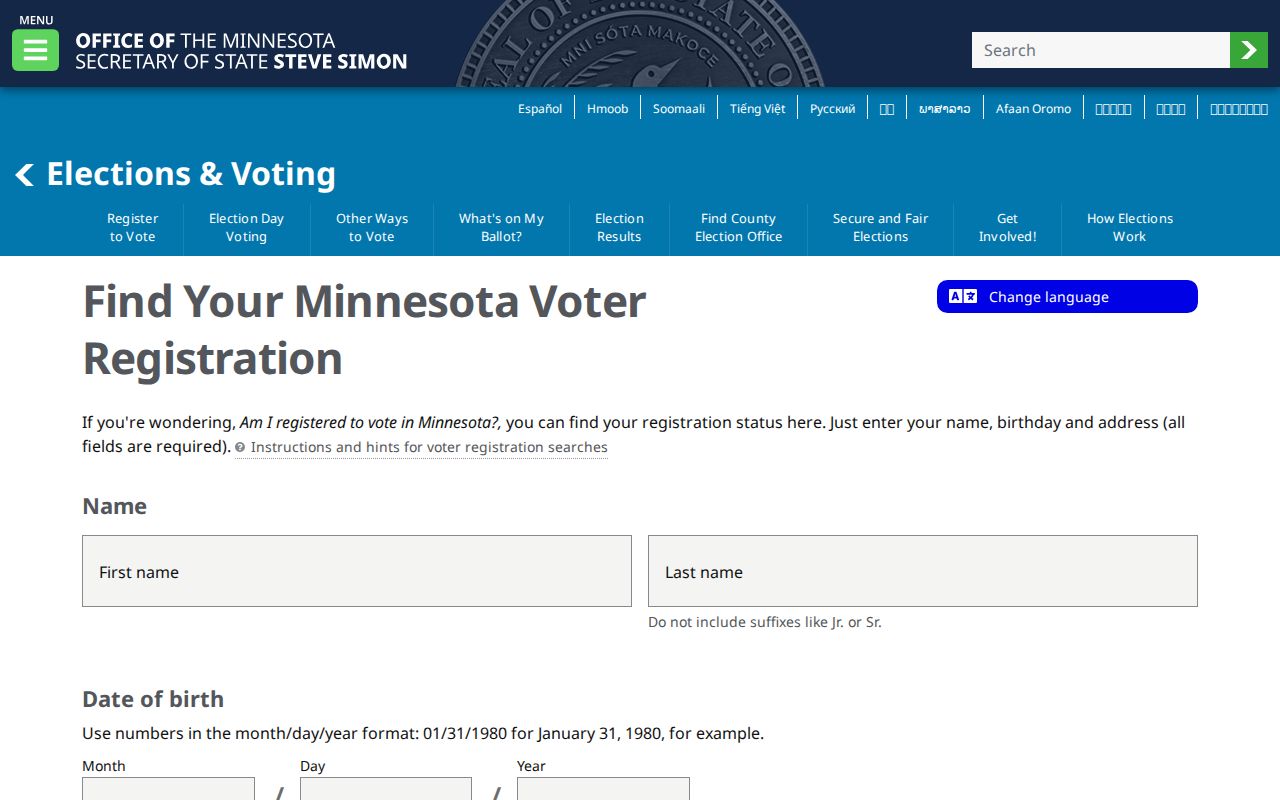
The fields help explain why a complete name, valid house number, street spelling, and unit matter. They do not authorize copying a registration response into a personal roster.
| Lookup label | Entry type | Format or route |
|---|---|---|
| First and last name | Required | Letters, spaces, hyphens, and apostrophes only. |
| Date of birth | Required | Individual status lookup input. |
| ZIP code or county | Route choice | Starts an address path. |
| City/township, house, street | Address fields | Use the selected street and numeric house number. |
| Unit checkbox | Optional | Reveals a unit-number field when needed. |
Faribault Recorded Land Name Trail
For a Faribault address, the Recorder's index answers a different question than the Assessor map. A recorded instrument can identify parties, document type, recording date, and the legal land reference. Rice County maintains both Abstract and Torrens systems. In an Abstract system, follow deeds, mortgages, releases, and related instruments. In a Torrens matter, the certificate of title is central and the Recorder acts as Registrar of Titles under District Court authority. Determine the system before assuming a single title path.
LandShark is the county-linked remote route for recorded documents and historic tract images, but it is a subscription service and its live search fields were not verified in the review. The Recorder's public research area and staff assistance remain the appropriate alternatives. For a large tract-image request, the county form asks for section, township, range and result count for unplatted land, or a plat name or ID and result count for platted land. Requests with fewer than 25 results are not considered.
The Rice County Recorder page is the official starting point for public research, recorded-document service, and the LandShark route.
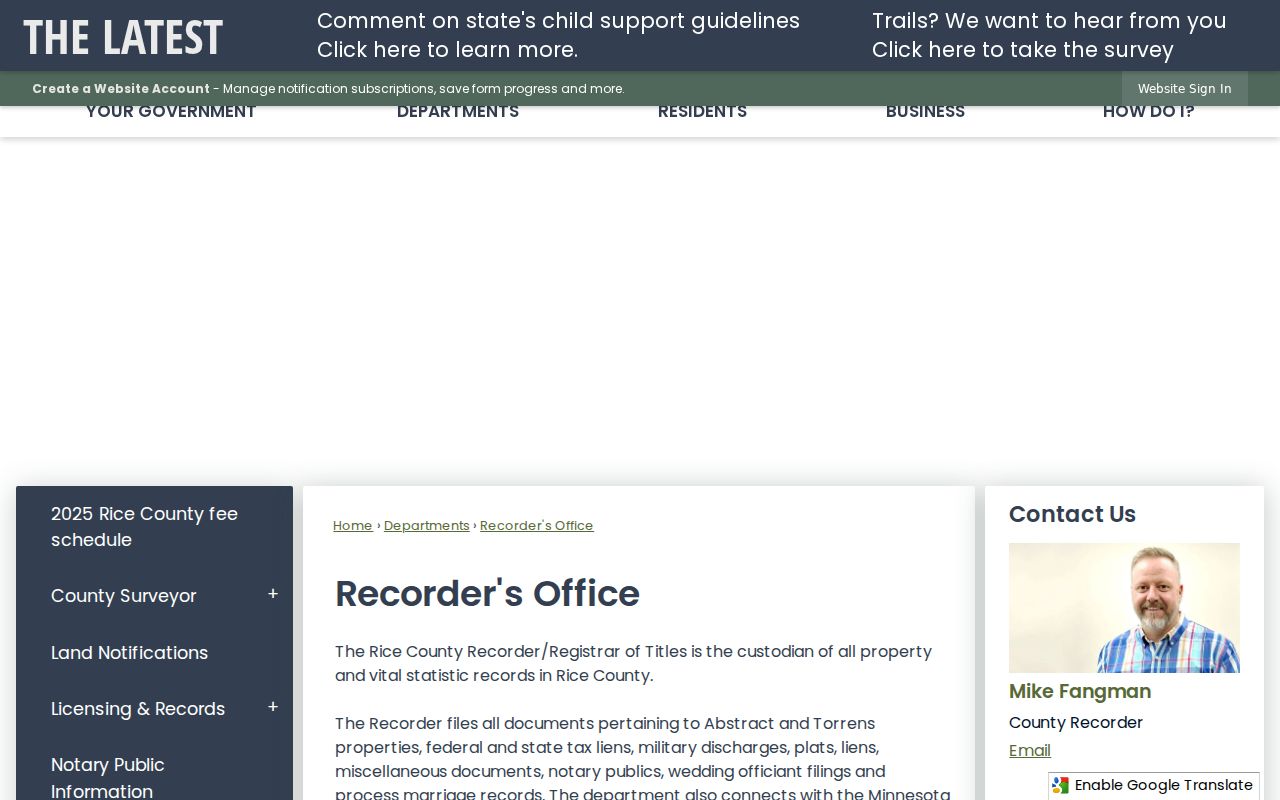
The Recorder's public research area remains important when a remote search does not show an older or high-volume record trail.
A grantor is a party conveying an interest. A grantee is the party receiving it. An index points to a record; it is not the image or certified copy itself. Keep linked instruments in order before drawing a conclusion about a parcel's history.
Current Faribault Residents Directory Sources
Current sources have different coverage and limits. The parcel layer can connect an address to land and an owner field. MNVotes handles an individual registration-status check. The Recorder indexes people or entities named in recorded instruments. Court and city files are records of an event, filing, or request, not a current household list. The Faribault residents directory is strongest when each result stays tied to its custodian and date.
| Faribault source | What it can connect | Custodian | Access route |
|---|---|---|---|
| Beacon and ArcGIS parcel records | Address, PIN, plat data, map, and owner or tax fields | Rice County Assessor | County web map and public service |
| Individual registration status | Status for a fully specified person and address | Minnesota Secretary of State / Rice Elections | Official lookup, then county help |
| Recorded-document index | Parties, document type, recording date, land records | Rice County Recorder | Public research area or LandShark |
| City records | Agendas, maps, permits, resolutions, and defined data series | City of Faribault | Archive or written request |
| Organization listings | Public organization contact and filing leads | Chamber or Minnesota agencies | Verify with the primary source |
When the question narrows to one person instead of an address or period, use the separate Faribault resident lookup route to compare a name against the correct official index. A result in one source can be old, incomplete, or about another person with the same name.
Faribault Court Records by Identifier
Minnesota Court Records Online, or MCRO, is the state access point for public court material. Case Search accepts a person, business, attorney, case number, citation number, or attorney bar number. Document Search needs a case number. Hearing Search can use a person, business, case number, judicial officer, attorney, or bar number. Judgment Search uses a debtor name for qualifying money judgments. These are separate search paths, so a no-result in one tab does not settle the question.
MCRO's remote public-document coverage is limited by case category and filing date. Specified criminal, civil, probate, guardianship, conservatorship, and trust documents from July 1, 2015 are available under the court's rules, while family and paternity material is narrower. Older or excluded public material may require the courthouse terminal, local paper files, or a request to Rice County Court Administration at 218 Third St NW. A docket is the running court record; a Register of Actions lists filed steps, orders, and costs.
- Case number and title or parties
- Case type and filing date
- Register of Actions, where available
- Public documents, hearings, or judgments under access rules
Faribault City Data Request Route
For a city-created record that has no public search screen, make a narrow request under the Minnesota Government Data Practices Act. Minn. Stat. ch. 13, especially section 13.03, starts from public access unless another law classifies the data. It does not require an agency to create a new list or answer a new analytical question. A request for an ordinance, a permit number, a map, a meeting packet, or a defined date range gives the city a workable record series.
The Faribault data-request form is the practical intake route. It asks for contact details and a description of the data, and it can be mailed, emailed through the City Clerk route shown on the form, or delivered at City Hall. Ask for inspection, copies, a particular image, or electronic transmission as needed. If a portion is withheld, ask for the classification and any public portion that can be separated.
The official form shown here is useful because it asks the requester to describe a specific record rather than ask for a profile of a person.
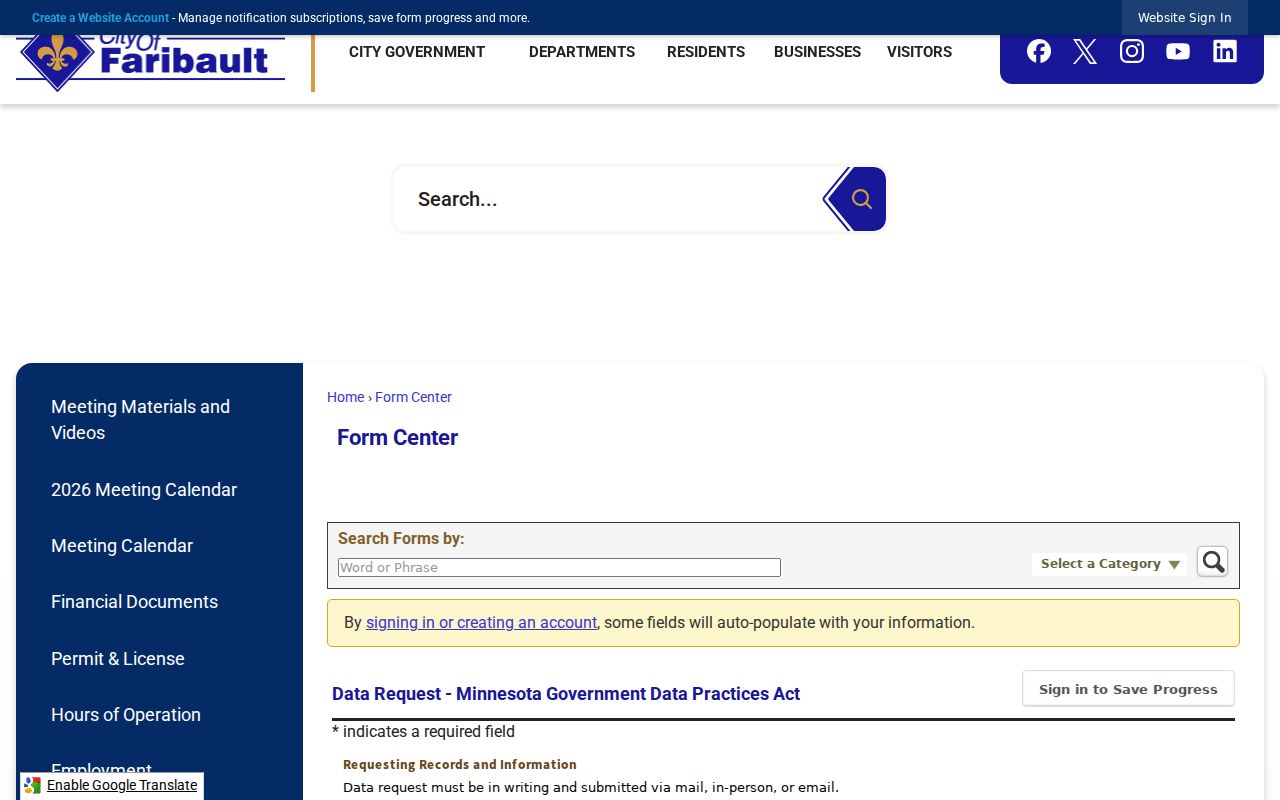
City permits, planning files, council materials, maps, and police records each have their own classification and department route. Include an address, date, file number, or permit number when one is known.
Faribault Vital and Organization Records
Vital records have a different access route from parcel and city files. Rice County Recorder provides local birth, death, and marriage service, while the Minnesota Department of Health Vital Records route handles statewide material. Death records are public, but birth records can be public or confidential depending on the record and circumstances. A nonpublic birth record generally becomes public after 100 years. Certified copies require an eligible requester, identity and signature, plus notarization or county vital-records staff verification.
Marriage certificates are obtained from the county where the application was made, and a divorce decree comes from the district court that granted it. Keep a request focused on the record type, date, county, and names as they appeared at the time. For a Faribault organization, use the Minnesota Secretary of State Business Search by business name or file number. An entity filing is a state record of the filing relationship, not proof of a current personal connection. State licensing directories are separate, and their status dates should be recorded before relying on a result.
Faribault Address and ZIP Checks
The City of Faribault's 2009 ZIP Code Area Map documents 55021 for the city, but it is not a current delivery guarantee. A postal delivery area, city limit, precinct, parcel post community, and township are separate geographies. Use the exact-address U.S. Postal Service route for present delivery validation, then compare the result with the county parcel's ZIP and ZIP4 fields and the city's street or address map. A legal description and county PIN carry more weight than a ZIP for a recorded-document search.
Historical sources need another layer of care. A directory can use a directional suffix, a former street spelling, or a number that later changed. Pair the directory year with a city map, plat book, Sanborn sheet, or newspaper item before connecting it to a modern parcel. The official city map is a useful dated reference; it should not be used to define a current postal boundary beyond what the research supports.
Faribault Resident Records and Safety
Public availability has limits. Minnesota voter information has a separate withholding process under section 201.091, and Safe at Home provides address confidentiality for people who need it. Birth records can be public or confidential depending on the record and circumstances. A public parcel field can also sit beside private or protected information. Use the official custodian to correct, withhold, or classify a record rather than trying to reconstruct an address from scattered sources.
For a safety concern, use the Minnesota Safe at Home program, the voter-withholding route, or the relevant court or law-enforcement channel. Do not publish full dates of birth, driver-license data, protected addresses, or other unnecessary identifying details from a source screen.
Comparing Faribault Directory Evidence
Official records and commercial people-finder products are not interchangeable. A county or state custodian can identify the field, date, office, and access rule behind a record. A commercial compilation may be convenient, but it can combine stale entries, omit context, or fail to show the source that should correct an error. For a Faribault residents directory question, return to the custodian when the result matters.
| Research route | Best use | Check before relying |
|---|---|---|
| Official county or state record | Parcel, filing, registration status, court, or certificate route | Custodian, date, scope, and any access limit |
| Library or archive collection | Dated address, newspaper, map, directory, or family-history question | Volume, page, collection, and reproduction rules |
| Commercial compilation | Only a possible lead to verify independently | Underlying source, date, identity match, and correction path |
Rice County Tract Images by Era
Rice County's tract-book digitization is a local strength for land history. A county report describes more than 16,000 historic tract-book images spanning 1854 through the 1990s. Before that project, the digital index was approximately 1987 forward and older tract books were physical. The images now bridge an early legal-description search to more recent recorded-document work, while public research terminals and staff assistance remain part of the access route.
That figure describes the collection, not a promise that every name, image, or field is searchable from home. Start with the parcel's legal description and determine whether it is Abstract or Torrens. Then ask the Recorder which index, physical book, image request, or LandShark path fits the date. This is especially useful for family or estate research because the legal description can persist when a street address changes.
Faribault Residents Directory History Shelf
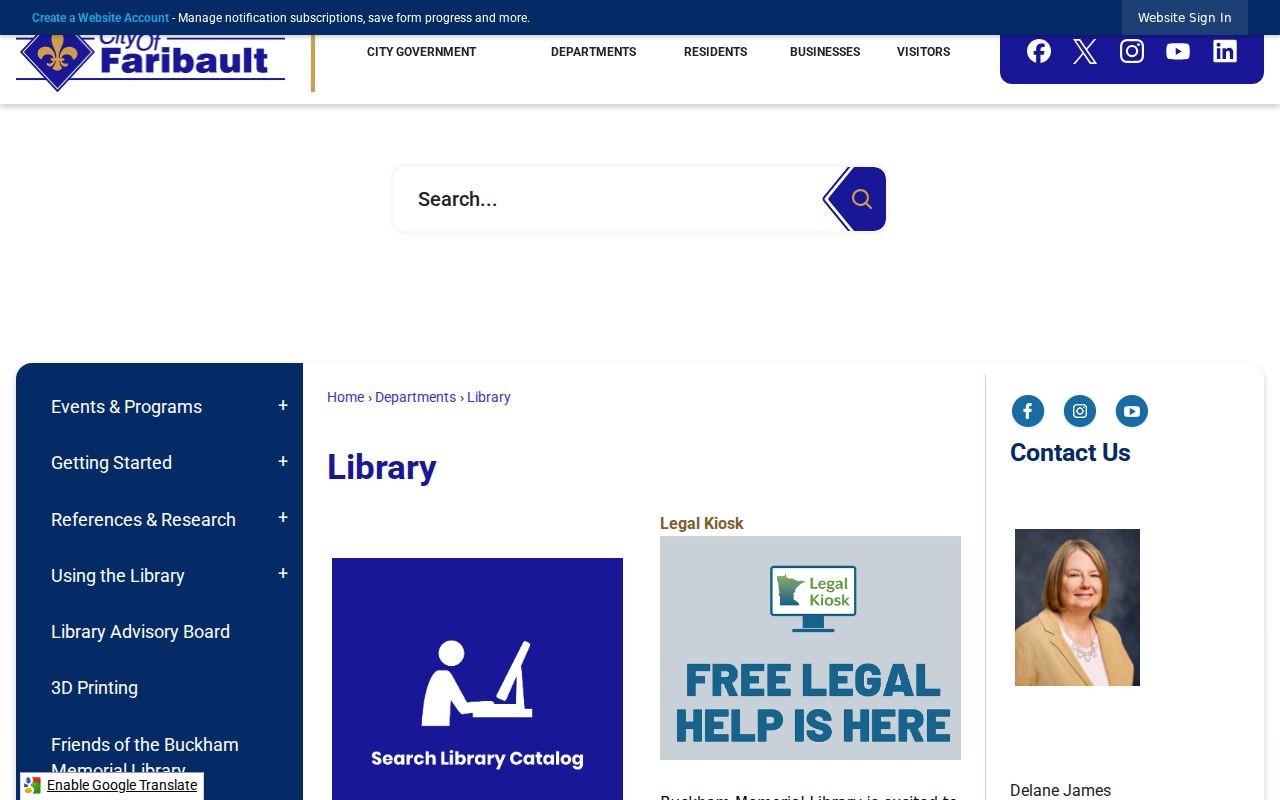
Faribault's historical resident trail is strongest at Buckham Memorial Library and the Rice County Historical Society. Buckham's Local History Room holds books, documents, and newspaper microfilm, with Faribault newspapers reaching back to 1856. Its Dalby Database brings together cemetery records, plats, articles, church material, marriages, births, Civil War veterans, and directory leads. HeritageQuest can be used remotely with a qualifying library card, while Ancestry Library is an in-library resource.
Buckham Memorial Library provides the open-use local-history starting point. The captured page points readers to the library route before a search moves to a more specialized collection.
The Rice County Historical Society maintains the deeper staff-assisted shelf, including Polk directories, phone books, plat books, Sanborn maps, obituaries, photographs, and research files. Its verified Polk runs begin in 1880 and continue to 1993 with gaps. A volume can establish what was printed in that period, not that every household was listed or present.
The 1931 Faribault Courthouse Story
A February 25, 1931 fire destroyed the central Rice County courthouse and its west wing, while fireproof wings preserved important records. A later courthouse followed through a Works Progress Administration project in 1934. That history explains why an older court, naturalization, or administrative record may require a finding aid, a physical series, or a rebuilt numbering approach instead of a modern web search.
For records before the fire, a missing online result is a scoped gap, not evidence that an event did not occur. Minnesota Historical Society finding aids describe Rice County naturalization indexes, registers of actions, early criminal material, and historical municipal-court series. Cite the series title, date range, and geographic subject when asking an archive for an index check or appointment.
Faribault Research Gaps to Confirm
Several live interfaces could not be fully inspected. Beacon returned an access limitation, LandShark subscription fields were not published in the reviewed static material, and no line-level Polk directory scan was confirmed in the public digital collection. The city permit software launched in 2025, so its current search fields also need direct confirmation. These gaps do not erase the official routes. They identify where an in-person terminal, staff request, or live portal check is needed.
Record a source URL or collection number, custodian, coverage date, search key, and retrieval date with each Faribault result. For an old directory, add the volume year and page. For a parcel, add the PIN. For a court result, add the case number and public-access status. That recordkeeping makes it possible to correct a weak match without turning an uncertain lead into a claim.