
Faribault Previous Residents, Source by Source
A backward address search is an era-by-era task. The Recorder supplies the recorded land trail, while the Rice County Historical Society and Buckham Memorial Library hold many of the local sources that can place past residents at a street address. The table separates verified collection coverage from a claim that any source is complete. A deed may show a transfer, a directory can locate a listed household at publication time, and a map can show the building or lot without naming a person.
| Source | Years It Covers | Where Held | What It Shows |
|---|---|---|---|
| Faribault-area Rice County historic tract books | 1854 through the 1990s | LandShark tract module, Faribault Recorder research area, or staff assistance | Faribault historic land-record bridge for a legal description or tract. |
| Faribault RCHS Polk directories | 1880 through 1993, with gaps | Faribault Rice County Historical Society Research Library | Faribault period directory entries for a name or address search. |
| Faribault RCHS phone books | Many years from 1920 through early 2000s | Faribault Rice County Historical Society Research Library | Another Faribault period address and name source. |
| Federal census | Through 1950 for the public release | NARA and library research tools | Household snapshot for its census year. |
| Faribault newspapers and obituary files | Microfilm from 1856; RCHS obituary files 1936 to present | Buckham and RCHS | Dated notices, reports, and family-history leads. |
For a recent Faribault deed question, begin with the Faribault parcel and Recorder. For an older Faribault address question, begin with the street spelling and nearest available directory year, then use the Faribault land and map sources to test whether the location stayed the same.
Set the Faribault Previous Residents Time Window
Write down the Faribault address, the approximate Faribault year, and the Faribault geography first. “Faribault” can mean the incorporated city, a Faribault mailing address outside city limits, or a Rice County record that concerns a nearby township. Include a Faribault directional suffix and the address format shown in the source. Faribault city street and address maps, period plat books, and Sanborn sheets can help test an old number before it is matched to a current parcel.
Do not use a current Faribault owner field to fill a gap in an old Faribault directory. Likewise, an absence in one Faribault Polk volume is a limited result, not proof that nobody was there. Record the Faribault volume, page or image, search spelling, and the time span searched. That note makes it possible to compare the volume immediately before and after the year in question.
Faribault Previous Residents and Rice County Title Records
The Rice County real-estate recording guide explains an essential distinction. In the Abstract system, title history is followed through deeds, mortgages, releases, and related instruments. In Torrens, the certificate of title is the central title record and the Recorder acts as Registrar of Titles under District Court authority. Determine the system before reading a parcel history. An assessor field can identify a starting point, but it does not replace a recorded instrument search.
The Recorder's real-estate recording overview below shows the local route for a Faribault previous residents search that needs property-record context.
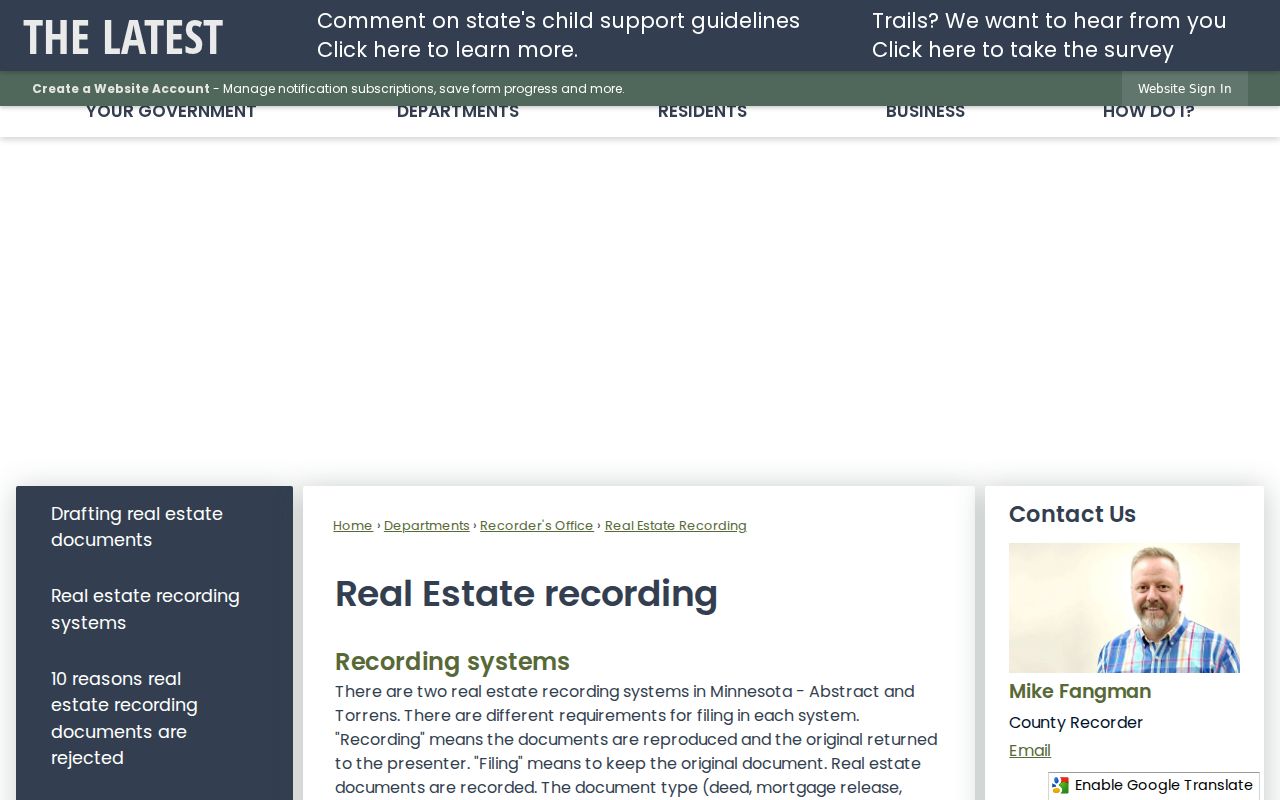
Rice County says Faribault recorded documents and historic tract-image research are available through the county-linked LandShark route, with Faribault public terminals and staff assistance also available. Its Faribault online index was approximately 1987 forward before the tract-book digitization project, so a missing remote hit may require the Faribault public research area, staff help, or a physical record route.
Trace Faribault Previous Residents Through a Rice County Deed Chain
A Faribault deed chain follows instruments, not assumptions about an address. Start with a current Faribault parcel record only to capture the county PIN, legal description, lot or block, plat, and whether the land is Abstract or Torrens. Then use the Faribault grantee and grantor indexing route to move through transfers. Keep document numbers and Faribault recording dates at every step, and inspect the image or obtain a copy before treating the index entry as evidence of the instrument.
- Find the Faribault property in Rice Beacon or the parcel layer and copy the PIN, legal description, plat, lot or block, and recorded-date context.
- Ask the Faribault Recorder or use the applicable LandShark route to find the current owner's acquisition instrument.
- Read the Faribault instrument's grantor, grantee, document number, recording date, and legal description, then search the earlier transfer through the matching party and tract.
- Repeat the Faribault chain while checking each legal description. Stop and ask Recorder staff for the correct index path if Abstract and Torrens records are being confused.
- For early Faribault material, use the historic tract-book route, public research area, or staff assistance instead of assuming the web index is complete.
- Grantor and grantee
- The grantor transfers an interest in an instrument; the grantee receives that stated interest.
- Chain of title
- A sequence of recorded instruments that traces an interest in land through time.
- Legal description
- The lot, block, plat, section, township, range, or other land description used to identify the parcel more reliably than a changing street number.
- Certificate of title
- The central title record in the Torrens system, maintained through the Recorder acting as Registrar of Titles.
Faribault Previous Residents and Historic Tract Books
Rice County's Faribault tract-book digitization creates a useful bridge between early Faribault legal land research and modern Faribault parcel work. The county report describes more than 16,000 historic Faribault tract-book images covering 1854 through the 1990s. LandShark's Faribault tract module can expose this material, but the date span describes the collection, not a guarantee that every image or field is remotely searchable. Capture the Faribault tract description and compare it with the modern PIN before carrying a result forward.
For a high-volume Faribault tract image request, Rice County's combination form asks for section, township, and range on unplatted land, or a plat name or ID for platted land, plus the current result count. Faribault requests with fewer than 25 results are not considered and are processed as time allows. That is a targeted Faribault research channel, separate from an inspection at the Faribault Recorder's public research area.
Numbers matter. More than 16,000 tract-book images can assist a land trail, but each one still needs a parcel and legal-description check before it is connected to an address.
Faribault Previous Residents in Directories and Census Records
Faribault recorded ownership is only one part of who lived here before. For the period Faribault household layer, consult the Faribault collections through the Faribault city directory research path, then compare nearby Faribault Polk or phone-book years with the census. Faribault RCHS lists Polk volumes from 1880 through 1993 with gaps, exact phone-book runs beginning in 1920, and rural resident directories for 1980/81. It is a staff-assisted Faribault library, so a request should name the address, year, person, and collection.
- Choose the closest RCHS directory or phone-book volume before the target date and the closest one after it.
- Record the exact address spelling, directory year, page or scan, and all abbreviations rather than expanding them by guesswork.
- Pair the result with the public census year that best fits the interval. The 1950 Census is currently the latest released federal census under NARA's 72-year rule.
- Compare names and address evidence with a newspaper, obituary file, or recorded instrument, and preserve a scoped “no hit” when that is the result.
Different editions can format entries differently, and a verified line-level Faribault directory scan was not captured in the research. Use the volumes as source-specific evidence, not as a promise that each year names every person at every address.
Faribault Previous Residents in Maps and Newspaper Trails
Maps test the place; newspapers can test the date. RCHS holds Faribault Sanborn maps for 1884, 1893, 1899, 1905, 1909, 1921, and 1930, as well as plat books across many periods. The Library of Congress provides an 11-sheet May 1893 Faribault set, while Buckham's newspaper microfilm begins in 1856. A Sanborn sheet can show building footprints, street context, construction, and use, but it is not a resident list.
The Rice County Historical Society Research Library page documents its Polk directories, phone books, plats, Sanborn maps, obituaries, research files, and staff-assisted procedures.

Use a period map with a directory year and a newspaper issue to test one address. For obituary research, Buckham's prepaid copy route is separate from RCHS research: Buckham asks for a title or date search and charges $10 per obituary, while RCHS lists staff-research and copy charges for its own materials.
Faribault Previous Residents Research Has Privacy Limits
Past records need context and restraint. A record can show an indexed instrument, a period directory listing, a census household, or a published notice. It does not establish a present address, current relationship, or current contact detail. Minnesota's Safe at Home program and voter-information withholding rules protect certain address information, and older sources may also contain errors, abbreviation choices, or gaps caused by publication cycles and lost records.
Lawful personal use. Use Faribault previous residents research for family history, local history, or understanding an address. Do not use a historic trail to watch, harass, or intimidate any living person, and verify important conclusions with the record custodian.