
Faribault Resident Lookup Records
No official source supplies a complete list of Faribault residents. Instead, use the record that answers the narrow question. Rice County's parcel tools can connect a name with an owner or tax-mailing field, not prove who presently lives there. MNVotes is an individual registration-status tool. MCRO is a court access layer with publication limits. Vital, marriage, license, and filing records each have a separate custodian and eligibility path.
| Record | What It Confirms | Where | Access |
|---|---|---|---|
| Parcel/map record | Owner or tax-mailing fields, parcel identifier, address, and map context | Rice County Beacon and ArcGIS parcel layer | Public county web tools; live Beacon labels should be checked |
| Registration status | Status for an individual using the required identifying fields | Minnesota Secretary of State MNVotes | Individual lookup; not a bulk name search |
| Court case record | Public case, filing, hearing, judgment, or document information within published scope | Minnesota Court Records Online and Rice County Court Administration | MCRO has no search charge; terminals and files can be more complete |
| Vital and marriage record | A record event or a certificate route, subject to record classification and eligibility | Rice County Recorder and Minnesota Department of Health | Copy type and requester rules vary |
| License or filing | State credential or business filing relationship | State licensing boards and Minnesota Secretary of State | Public official lookups; status is time-sensitive |
Begin with the source closest to the question. A parcel PIN is valuable for land research. A case number is better for court material. A marriage date and both pre-marriage names are useful for the Rice County request form. A name alone is only a starting point, especially when it is common.
Faribault Resident Lookup Through MNVotes
MNVotes is Minnesota's official tool for an individual's registration status. It asks for first name, last name, date of birth, and either a ZIP or county route. It then uses city or township, numeric house number, selected street, and an apartment or unit field when needed. The interface is updated nightly. A new application can take up to 14 days and appears the day after processing, so a recent move or application may need a follow-up with Rice County Elections.
| Name | First and last name using letters, spaces, hyphens, or apostrophes. The interface does not accept accents or diacritics. |
|---|---|
| Date of birth | Month, day, and year are part of the individual status route. |
| Location route | Start with ZIP or county, then use city or township, house number, and selected street. |
| Unit detail | Use the apartment or unit option when the address has one. |
The MNVotes registration lookup is the official source for the name, date, and address-field route described here.
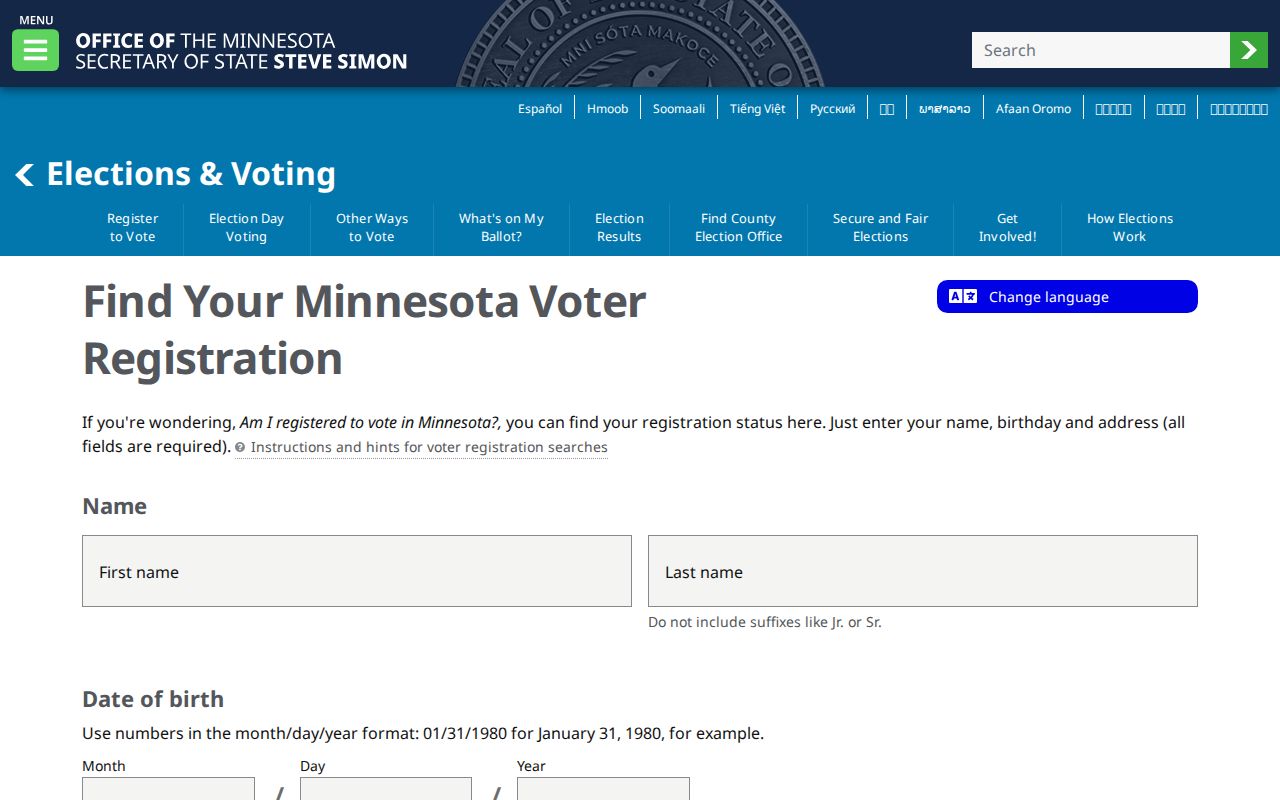
For a failed street, spelling, unit, or recent-change question, contact Rice County Property Tax & Elections at 320 Third St NW. The public information list is a different product. It is limited to registered Minnesota voters and election, political, or law-enforcement purposes, so it should not be treated as a general person-finding tool.
Faribault Resident Lookup in Court Records
Minnesota Court Records Online, or MCRO, offers four distinct paths. Case Search accepts person, business, attorney, case number, citation number, or attorney bar number. Document Search uses a case number. Hearing Search can use a person, business, case number, judicial officer, attorney, or bar number. Judgment Search uses a debtor name for money judgments and satisfactions. Keep the selected path in your notes because one search screen does not stand in for the others.
MCRO can show a case number, title or parties, case type, filing date, Register of Actions, public documents, hearings, and judgments when publication rules allow it. The Register of Actions is the chronological court list of filings and orders. Public documents filed from July 1, 2015 have broader availability for major and minor criminal and civil cases, along with listed probate, guardianship, conservatorship, and trust categories. Several sensitive categories are excluded or narrower, and older material can require the courthouse route.
Older Rice County court research has a local records story behind it. The February 25, 1931 courthouse fire destroyed the central courthouse and west wing, while fireproof wings preserved important records. Later finding aids note complications from the fire and changed early case numbering. A missing MCRO result for an early matter is not proof that no record exists. Ask Rice County Court Administration or the Minnesota Historical Society about the relevant surviving series and finding aid.
- Case number: the identifier to retain for a document or counter request.
- Case title or parties: a starting point that still needs a second identifier for common names.
- Case type and filing date: the context for deciding whether the record fits the person and period.
- Register of Actions: the chronological list of public case activity where available.
- Public document, hearing, or judgment result: an item whose visibility depends on the court's publication rules.
Verifying a Faribault Resident Record
A sound Faribault resident lookup checks independent details rather than matching a name by itself. Start with an official source and note the URL or collection, custodian, coverage date, search date, and exact search spelling. Add an address, birth year where lawfully available, parcel PIN, case number, organization file number, or record date. A present property field is not proof of occupancy, and a historical directory entry does not establish a current connection.
- Write down the name form and one anchor detail, such as a known street, date, parcel PIN, or case number.
- Use the official county parcel route only to test property context, then record the PIN and map date.
- Search MCRO by the appropriate tab and compare case number, type, filing date, and any public document scope.
- Use the relevant vital, marriage, license, or business custodian only when that specific record can resolve the remaining question.
- Request the underlying record or a certified copy from the custodian if the purpose requires one, and retain the response date.
- Docket
- A court's organized list of activity in a case. MCRO calls the chronological activity record a Register of Actions.
- Index versus image
- An index helps locate a record; an image or underlying document is the actual public document when access rules allow it.
- Certified copy
- A copy issued and certified by the record custodian. It is different from an ordinary inspection or reference copy.
For a street or parcel question, the Faribault street directory gives the address-focused chain. It is better to preserve a conflict between sources than to force two same-name records into one identity.
Faribault Resident Lookup Vital Records
Minnesota Department of Health Vital Records and the Rice County Recorder divide this work. MDH reports Minnesota birth records from 1900 and death records from 1908. Birth records can be public or confidential depending on the record and circumstances. A nonpublic birth record generally becomes public after 100 years. Death information is generally public, while certificate procedures and identity requirements still apply.
Rice County holds marriage records from 1856 to the present when the application was made in Rice County. Its certified marriage-copy form asks for both applicants' names before marriage and the date of marriage. The statewide MOMS database can help orient a search, but the certified copy comes from the county where the application was made. A divorce decree comes from the district court that granted it, not from MDH.
MDH's certified-copy eligibility guidance explains the requester's relationship, identity, signature, and verification requirements for restricted records.
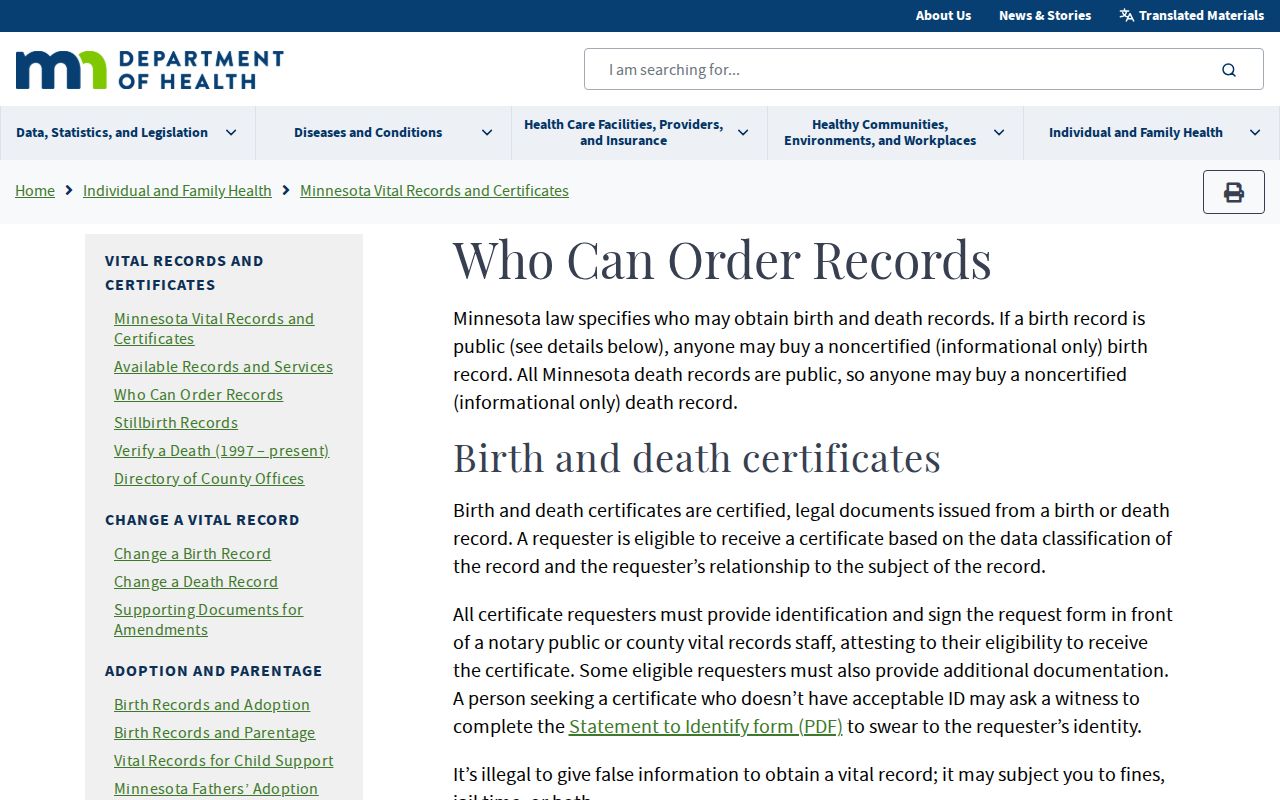
The eligibility screen is a reminder to choose the right product. A certificate, an index, and an application are not interchangeable. MDH accepts purchased-record orders by mail or fax and does not provide in-person state-office service; county vital-record offices can offer in-person or mail routes. Processing information and fees change, so confirm them with the custodian before ordering.
Faribault Resident Lookup License Checks
Official license and filing databases can verify a narrow public relationship. The Minnesota Secretary of State Business Search accepts a business name or file number and has active or inactive choices. Its detail route leads to filing, renewal, copy, and certificate information. Search an assumed name and the legal entity separately. A result shows a filing relationship with the state, not a complete profile of every person connected to an organization.
Minnesota health-provider and professional lookup tools are separate routes. The MDH provider directory can search by provider type, county, city, or name. The Medical Board profile can use name, city, license, specialty, or ZIP, and the AELSLAGID tool accepts full or partial last name or license number. Record the board, credential number, status, issue or expiration date when shown, exact spelling, and retrieval date. An expired, inactive, suspended, retired, or not-found status is a portal condition, not a conclusion about a person's character.
Faribault Resident Lookup Public-Safety Limits
Current custody and court information are different records. The Rice County Jail page links a vendor-hosted roster that can display a photo, name, booked date, and charges. It changes frequently and may not explain release, dismissal, disposition, aliases, or the status of a charge. A warrant list is also time-bound and is not a conviction. Use the county-linked source, retain the retrieval date, and confirm a current status with the issuing authority or court.
The Minnesota DOC locator covers committed adults or people under supervision, not every person ever arrested in Faribault. Minnesota VINE is a separate notification service, not an all-purpose local roster. The BCA public criminal-history process is separate again from a court docket, police report, jail roster, or DOC result. Faribault Police holds city records at 25 4th St NW, while the Rice County Sheriff's Office holds county records at 50 East View Drive. Use the custodian that created the record.
Lawful Faribault Resident Lookup Limits
Minnesota Government Data Practices Act section 13.03 starts with a public presumption but has explicit private and confidential classifications. It does not require an agency to create a new compilation or a format it does not maintain. Inspection is free, while copies can involve permitted actual costs. A focused request identifies the custodian, record series, date range, geography, identifiers, and preferred format. For city-held material, use the Faribault data-request form or the City Clerk route.
The Faribault data-request form is the city’s current written route for a defined public record series.
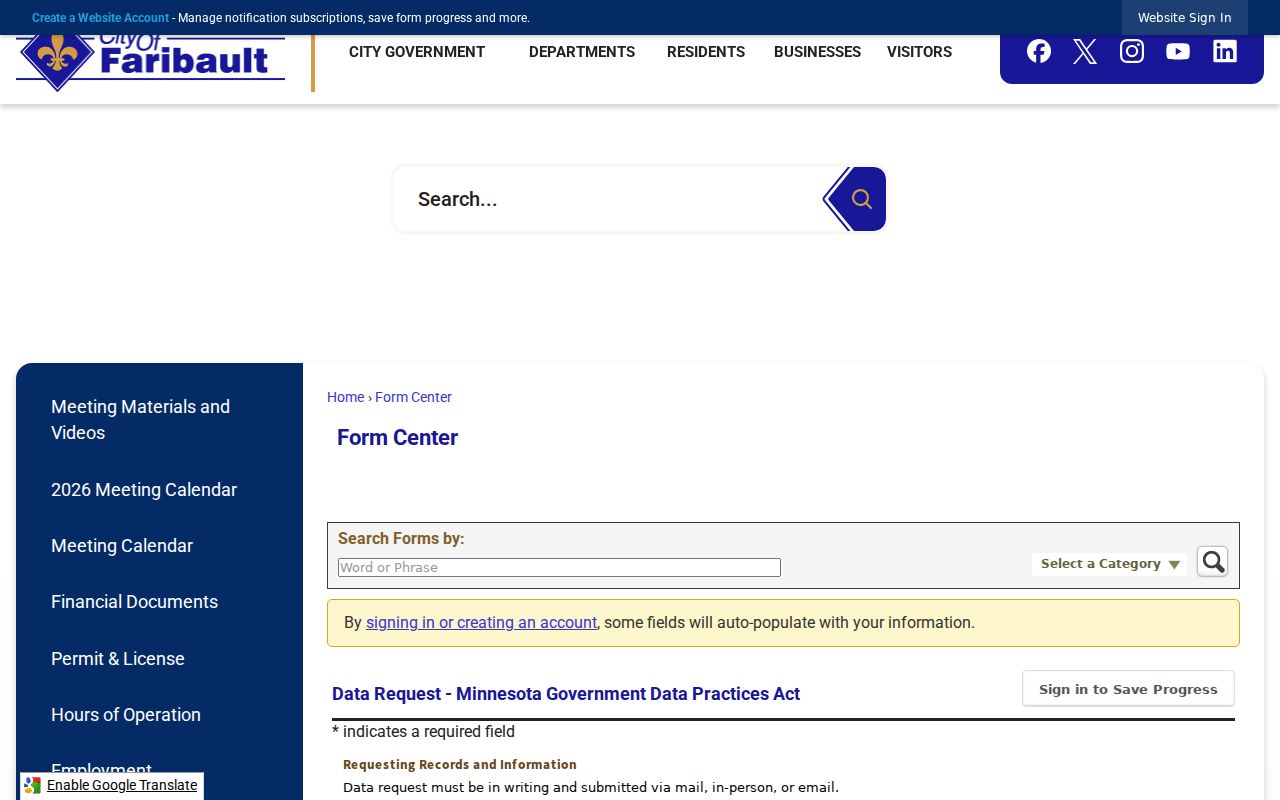
The form supports a focused request that names the data sought and the desired delivery route. It does not turn city records into a general name directory.
Safe at Home provides a designated mailing address and mail forwarding for eligible Minnesota participants. Minnesota also has a voter-information withholding route under section 201.091. Do not try to reconstruct a protected physical address from old records, parcel fields, or other sources. If a record is inaccurate, ask the custodian that owns it for the correction, redaction, withholding, or classification route rather than treating a search result as final.
Faribault Resident Lookup Custodian Follow-Up
When an official search does not resolve the question, follow the access channel for the record series. Rice County Court Administration is at 218 Third St NW and maintains court files; courthouse public terminals can provide more complete public electronic access for some material. The Recorder's public research area is the route for recorded documents and local vital services. City records go to the City Clerk or the relevant department. For historical clues, Buckham and the Rice County Historical Society can supply the local repository route.
Ask an office whether the issue is a missing record, a record held by another custodian, a private classification, or an excluded online result. That distinction avoids false conclusions. A dated search log should preserve the source, query, geography, result count, identifier, coverage, and next action. It also makes it possible to verify a result later without republishing sensitive fields.